|
Home Page
LLADRÓ(No Brand Name) Nalda Value FAQs "Seconds" "Prototypes" Restoration FAQs Restoration (2) Restoration (3) Authenticity FAQs About Selling GlossaryFavorite LinksSlide Show
|
|
AND EVEN MORE FAQS ON DAMAGE AND RESTORATION"I have a long-retired Lladró that's lightly crazed all over its surface. The antique dealer I bought it from said this is normal as fine porcelain ages. Did I get taken?"I'm afraid you did. Crazing or "crackling" is a normal part of aging in some types of semi-porcelains and pottery. (English wares such as Beswick figurines and antique Staffordshire seem especially prone to it.) However, hard-paste porcelain (AKA "true porcelain"), which is the material of which Lladrós are made, should not ordinarily craze even with age. (When's the last time you saw a crazed Royal Copenhagen? You won't find many crazed Meissens, either, and the only "crackling" you'll see on most very old Chinese porcelain is a deliberate production technique called "Crackle Ware.") So if you have a Lladró with crazing, it has surely been left too close to a heat source at some time in its display life. Crazing will sometimes also result from an unsuccessful restoration."I bought a Lladró online, a girl playing a mandolin, and there's this really unsightly glob of yellowish glue that seems to be attaching the mandolin to the girl's body. The seller said this was applied at the factory. Could that be true?"A restorer and at least one other person I trust in the Lladró secondary market have informed me that the factory itself does occasionally use this yellowish "gunk" (my term) to adhere decorative elements to a figurine. Subsequently, I have noticed some of this on my own items, particularly for adhering heavier elements, such as parasols, in a model's hand. In my experience, this is usually subtly enough applied as to be noticeable only upon close inspection.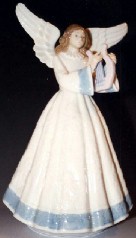 "Heavenly Harpist" (#5830) was one of several "treetop" angels issued by Lladró in the 1990s, this particular model in 1991. She's worth almost $300 USD - and the lyre is seamlessly adhered to her hands and body with liquid porcelain. (By the way, these treetop angels all had an abnormally large hole at the base to accommodate the spire of a Christmas tree. But, speaking of damage, I wouldn't dare! Luckily, the bases are stable enough for free-standing display.) (Photo by the author from her own collection.) Nevertheless, any visiblity at all of this gunk tends to be unsightly, and it is, as nearly as I can tell, indistinguishable from any other glue used in an amateur post-factory repair job. (To add insult to injury, the factory-applied yellow stuff doesn't even hold very well! Umbrellas and parasols adhered to models' hands using this substance seem especially prone to coming loose.) So I avoid any purchase on which I can detect obvious traces of this yellow substance. In my experience, most adhesions of decorative elements in Lladró and other fine porcelain are made with liquid porcelain "slip" that makes the attachment appear seamless - which is only as it should be! General Questions on Value
|


| Back to Top of Page · Back Home · Contact Us |
The logo background and side border graphic on this site are provided courtesy of Absolute Background Textures Archive (www.grsites.com/textures). All other content and graphics on this site are © Peggy Whiteneck. No reproduction of any part of this content is permitted without the express permission of the web site author.